Instructional Designer · M.Ed. · Navy Master Training Specialist

Professional instructional design, built at the speed of AI.

Twenty-six years running the full training lifecycle for the U.S. Navy, from task analysis to the evaluation that proves it worked. I now run that same lifecycle on AI-supported production. The discipline decides what gets built and whether it worked. With my oversight, the AI does the heavy lifting in between.

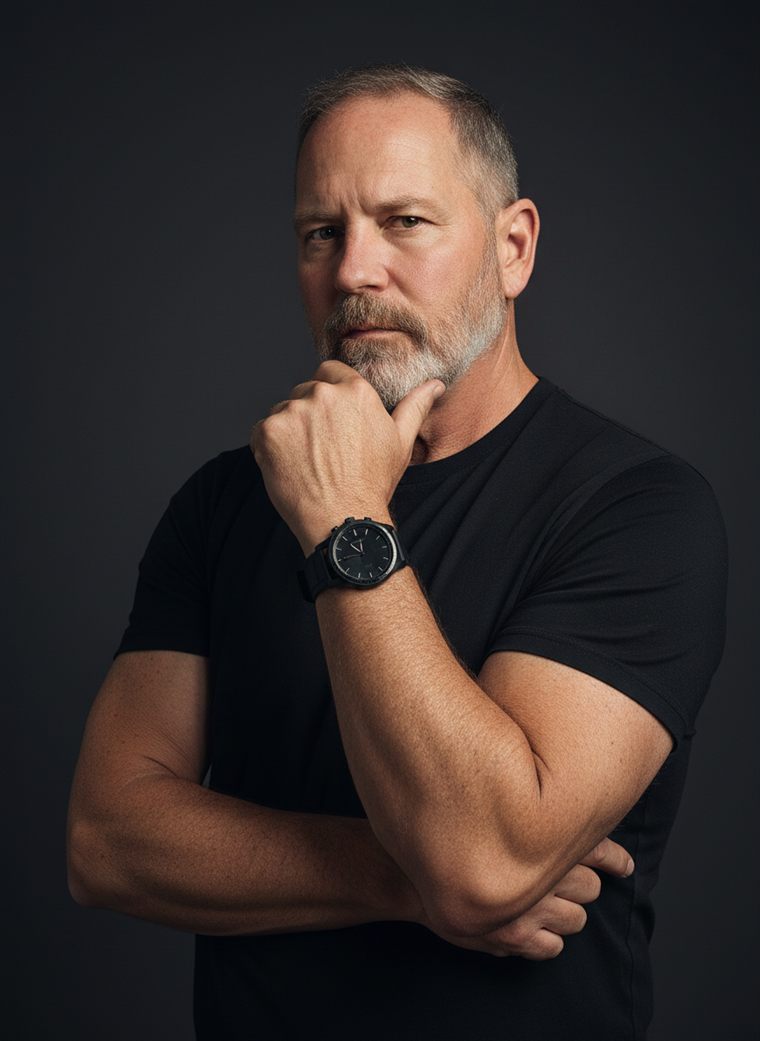
David M. Moore, instructional designer, in a black shirt against a plain background
Master Training Specialist
The Navy’s boarded, master-level qualification covering the whole training lifecycle, held since 2000
1998
in training and instructional systems, certified Navy Instructor since 1998
7,500+
learners across 85 course pipelines and 26 distinct curricula
1,800
finished learning assets built solo since 2024: 569 videos, 680 documents, 551 graphics
54
standard operating procedures authored and maintained for build, media, and publishing
Federal service 1987 to 2026: twenty years U.S. Navy, retired Senior Chief, followed by nineteen years as a Department of the Navy civilian training professional.
Selected work

Four ways to evaluate my work

A marked-up lesson that shows my hands on the page, the course it came from, a lesson you can watch, and four builds you can inspect. Each one names the problem, the approach, and what came out.

Raw AI, five blocks

Why Myths Matter: The Hidden Barriers to Your Next Chapter. As you transition from military to civilian life, you may encounter obstacles that aren’t always obvious. Misconceptions about veterans can quietly shape the opportunities you’re offered.

In this lesson, you’ll gain clarity on the misconceptions that can stand in your way. By the end, you’ll be better equipped to spot these myths...

Transitioning from military service to civilian employment or education comes with unique challenges...

The Civilian Transition: A Landscape of Opportunity and Challenge.

Designed, one block

The barriers you can’t see

You already beat obstacles most people can’t imagine. The ones left are quieter: assumptions others make about veterans that shape the jobs you’re offered and how you see yourself. Name them and they lose their grip.

Objectives
By the end, you can: name the three most common myths, explain where they come from, spot one in a real conversation.

Excerpt. The full page marks up the whole lesson, move by move.

01Markup · visible process

Raw AI vs. Designed

The same lesson twice: what an AI authoring tool produced, and the lesson after an instructional-design pass, annotated so you can see every decision.

  • ProblemAI-generated courseware reads fine and teaches poorly. Five intro blocks that say one thing, objectives you cannot assess, flashcards that restate the myth and never deliver the reality.
  • ApproachSeven named moves, applied in order and shown in red and green: cut redundancy, get to content, make interactions teach, trim filler, add one human line, remove tics, trim objectives to what is assessed.
  • ResultEighteen blocks to fifteen, four objectives to three with observable verbs, and the interaction that was teaching nothing now carries the lesson’s payoff. The one thing the AI got right was kept.

Tools: Articulate Rise AI Assistant, Mager-style objectives, cognitive load and coherence principles

See the full markup →

A veteran standing at a signpost, the opening image of the course After the Uniform
Format Articulate RiseLength about 10 minutesAssessment knowledge checks, scenario, graded quiz

Lesson 1 of this course is the designed column of the markup above. Same content, shipped.

02Live course · playable

After the Uniform: 3 Myths That Stall Your Transition

A short course for service members in transition. Three beliefs that quietly stall people, why each feels true, and the move that beats it.

  • ProblemTransition guidance is long on encouragement and short on anything a learner can practice. The audience is skeptical of both.
  • ApproachThree measurable objectives, one per myth. Each lesson runs myth, why it feels true, the reality, then a retrieval-practice check. A scenario asks the learner to spot the myth live before the graded quiz.
  • ResultA complete, accessible microlearning course: descriptive alt text on every image, observable-verb objectives, and a quiz that tests exactly what the objectives promised.

Tools: Articulate Rise 360, storyboard-first build, Bloom-aligned objectives, retrieval practice

Launch the course →

2:37. Captions are burned into the picture. Produced solo on a pipeline I designed.

03Video lesson · produced

How to Write an AI Prompt That Gets a Usable Answer

A two-and-a-half minute lesson teaching CRAFT, a five-part prompt framework I authored: Context, Role, Action, Format, Target/Tone. One term, taught once, properly.

  • ProblemPeople search a term once, get a definition, and still cannot do the thing. A video that explains is not a video that teaches.
  • ApproachScripted as a lesson, not a talk: hook, reframe, each element taught one at a time with the board filling in as it is narrated, then a before-and-after prompt assembled on screen. Every word on the board is composited in code so the image model never draws a letter.
  • ResultA finished lesson from five generated stills, synthetic narration, and burned captions, rendered by a script that produces both a social cut and a course cut from one source. This is the course cut, one of twenty-five in the series.

Tools: Python and ffmpeg render pipeline, reference-locked character generation, Kokoro narration, forced-alignment captions

How the pipeline works →
04Case studies · AI capability

AI-Assisted Development

Four systems where AI compressed production without cutting instructional rigor. Measured by output, not hours.

  • ProblemOne person, no crew, no studio, no per-project budget, and a catalog that needed a team’s worth of output at a consistent standard.
  • ApproachDesign the quality gates first (script, storyboard, assessment), then automate everything between them. Generated media is reference-locked for consistency and reviewed by a human before anything ships.
  • ResultA ten-minute educational video for roughly two dollars in media generation, a publishing engine that runs without me, a four-tier academy built solo, and a record that cannot drift from what actually shipped.

Tools: Claude, Python automation, ffmpeg, image and voice generation, WordPress API, GoHighLevel, Git

Read the case studies →

Anyone can generate a course now. The scarce skill is knowing which parts to throw away, and being able to prove the rest works.

Why the markup is first on this page
Process

Five phases, run to a standard that gets inspected

The Navy runs ADDIE as the Systematic Approach to Training and audits against it. Here is what each phase means when I do it, and the two working documents I build from.

  1. AnalyzeJob duty task analysis. Find the actual performance gap, not the one in the request. Decide whether training is even the fix.
  2. DesignObjectives with an observable verb, a condition, and a standard. Then the assessment that proves each one, before any content exists.
  3. DevelopStoryboard first, build second. Courseware held to cognitive load and multimedia principles, with assessment quality assurance on every item.
  4. ImplementDelivery held to standard. Instructor observation, qualification, and remediation. Designated Navy Testing Officer for test control.
  5. EvaluateDid performance change. Kirkpatrick levels chosen up front, data fed back into revision. The phase most portfolios skip, and the one an AI tool cannot do for you.
The sentence I use in interviews: I do not design to preference. I design to cognitive load theory and Mayer’s multimedia principles, I build in retrieval practice, and I write measurable objectives. Then I evaluate against them.
About

Four independent authorities certified me to build instruction.

The Navy boarded me as a Master Training Specialist. The academy awarded an M.Ed. in Curriculum and Instruction, summa cum laude. The federal government hired me as a GS-1750 Instructional Systems Specialist. Industry qualified me as a Cisco Networking Academy instructor. Theory, applied practice, and the credential to prove each, in the same craft.

I enlisted in 1987 as a Cryptologic Technician and spent eleven years as an operational maintenance technician, deployed ashore and afloat. In 1998 I was certified as a Navy Instructor, and in 2000 I earned Master Training Specialist, the qualification that covers the whole lifecycle: task analysis, curriculum development, test and measurement, training-system management, and the evaluation of other instructors. I retired from the Navy in 2007 as a Senior Chief and went straight into nineteen years as a Department of the Navy civilian, first as a Training Instructor and finally as an Instructional Systems Specialist at the Center for Information Warfare Training, retiring in January 2026.

Since 2024 I have run Rhynowerks, where I design and produce complete courses and instructional video, and where I built the AI production pipeline shown above. Same lifecycle, my own product, no one to hide behind.

  • EducationM.Ed., Curriculum and Instruction, summa cum laude · B.S., Liberal Arts, emphasis in education and adult psychology · A.A.S., Technical Studies
  • NavyMaster Training Specialist (2000) · Certified Navy Instructor (1998) · Designated Testing Officer · Retired Senior Chief Petty Officer, E-8
  • FederalInstructional Systems Specialist, GS-1750 · Training Instructor, GS-1712 · Center for Information Warfare Training, Pensacola
  • IndustryQualified Cisco Networking Academy Instructor · CompTIA A+
Role
Instructional Designer · Instructional Systems Specialist
Experience
Certified Navy instructor since 1998
Service
20 years U.S. Navy and 19 years Department of the Navy civilian, 1987 to 2026
Methods
ADDIE and Systematic Approach to Training, job duty task analysis, criterion-referenced assessment, Kirkpatrick evaluation
Tools
Articulate Rise and Storyline, SCORM and xAPI, Navy ILE, Camtasia, an AI production stack of my own design
Location
Pensacola, Florida · remote or on site
Now
Founder, Rhynowerks, 2024 to present · open to instructional-design roles
Contact

If your training has to work, let’s talk.

Open to instructional-design and eLearning-development roles, contract or full time, remote or in the Pensacola area. Email is the fastest way to reach me.

davidmmoore.careers@gmail.com

LinkedIn: linkedin.com/in/rhynowerks

Resume

Two pages covering the full lifecycle, the AI production work, and every credential named on this page.

Download the PDF

Lane-specific versions for cleared, remote, and training-delivery roles are available on request.